All Voids
.jpg)
.jpg)
.jpg)
.jpg)
.jpg)
.jpg)
.jpg)
.jpg)
.jpg)
.jpg)
.jpg)
.jpg)
.jpg)
.jpg)
.jpg)
.jpg)
.jpg)
.jpg)
.jpg)
.jpg)
.jpg)
.jpg)
.jpg)
.jpg)
.jpg)
.jpg)
.jpg)
.jpg)
.jpg)
.jpg)
.jpg)
.jpg)
LET THE CITY BREATHE !
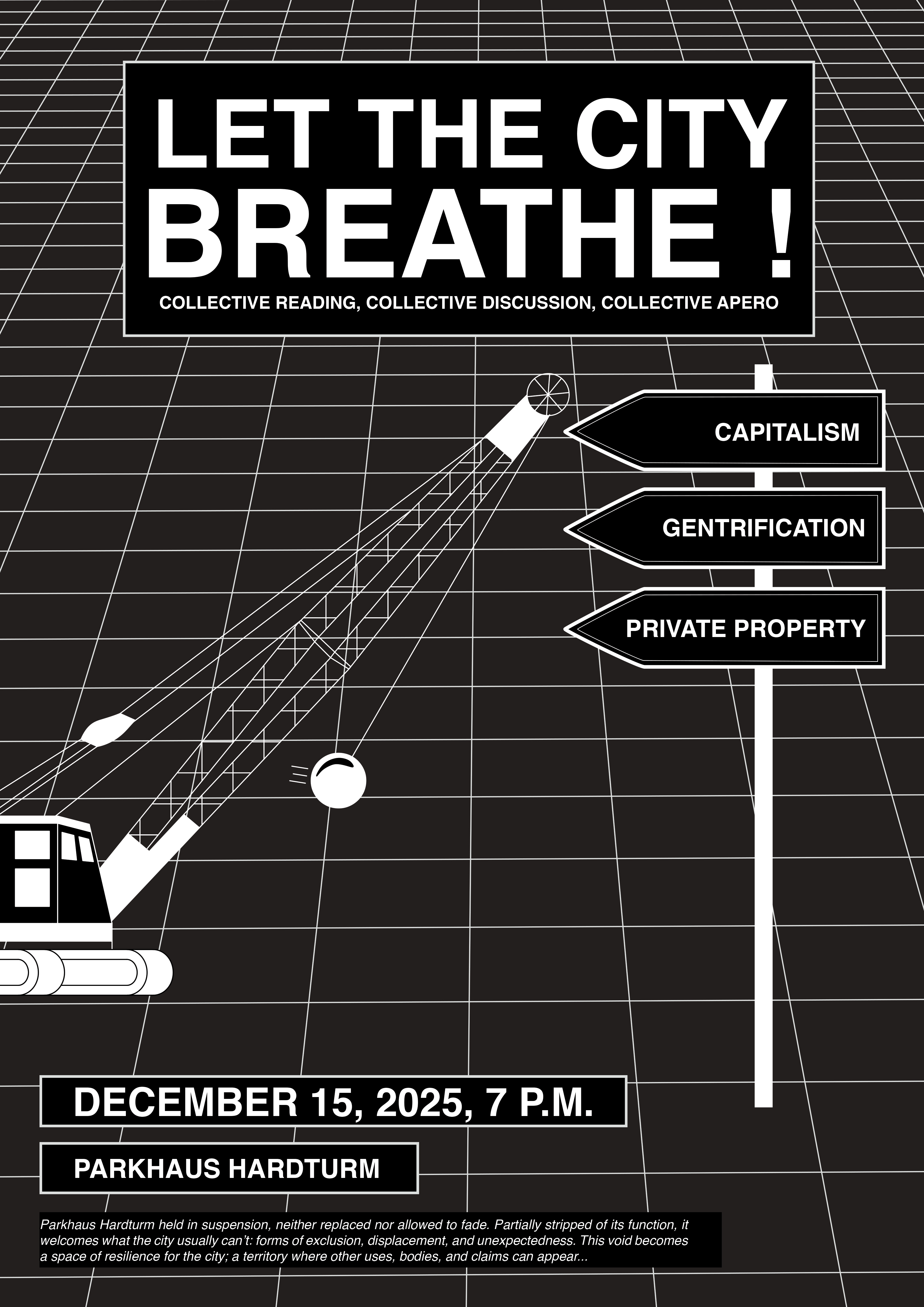
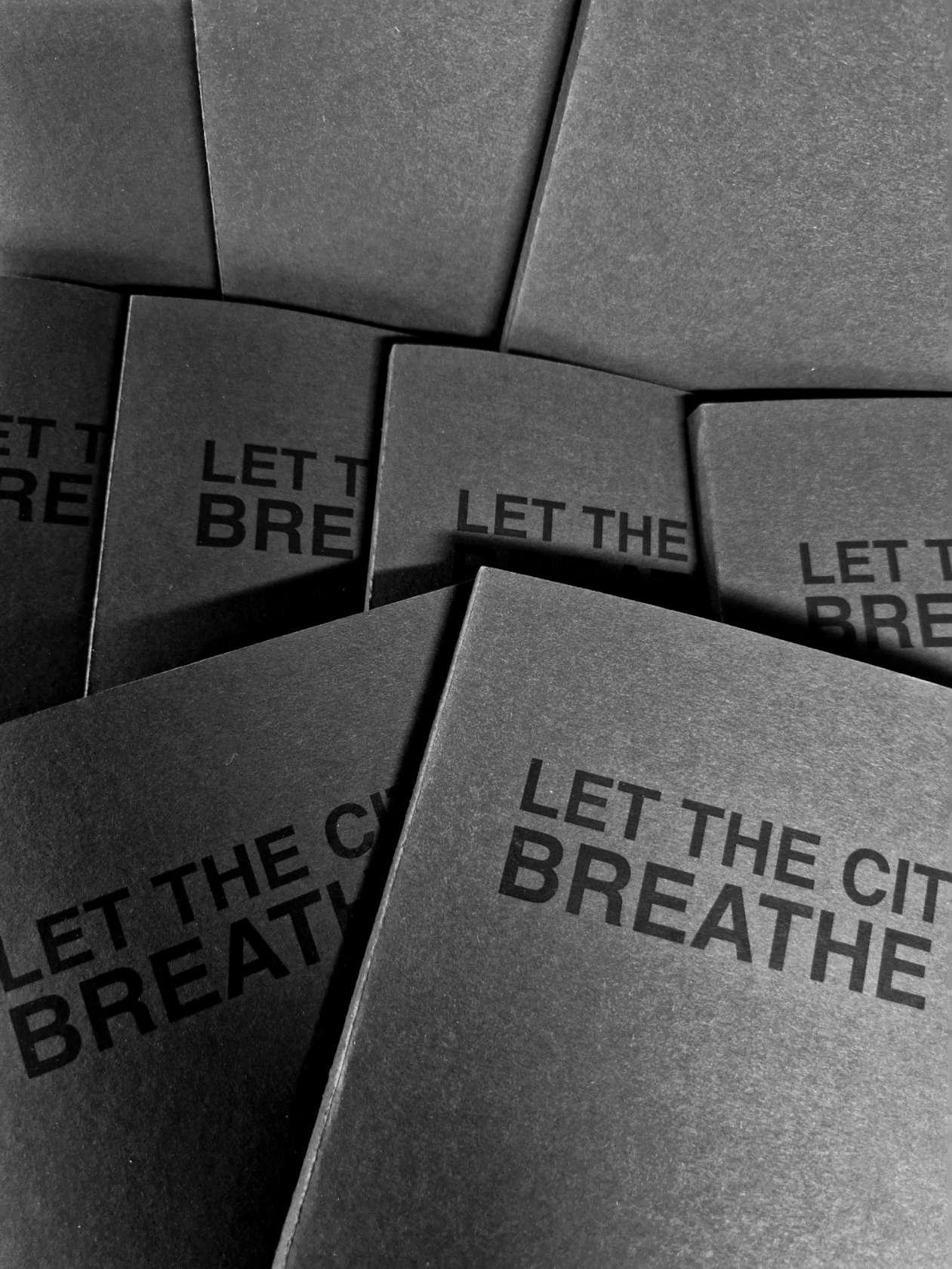
The contemporary city is often reduced to a functional machine, a complex assemblage of economic and political logics where space is organized solely for efficiency and capital accumulation. Yet, within this rigid framework, the Hardturm Parkhaus in Zurich stands as a living ruin that defies standard categorization. It represents a pause in the urban fabric, a void that is neither empty nor neutral but dense with invisible relations, rhythms, and memories. Our project, Let the City Breathe, utilizes the medium of the graphic novel to document these underdetermined spaces, revealing that what official planning disregards as obsolete is actually a vital reservoir of urban resilience.
Modern planning tends to flatten the complexity of the territory through zoning maps and ownership boundaries, turning informal uses invisible simply because they do not generate profit. This legibility is not innocent, since it privileges what can be measured while erasing the lived reality of the city. We challenge this erasure through our chosen medium. Unlike conventional architectural tools that freeze space, the graphic novel captures the fourth dimension of architecture: the unfolding of time, the impact of weather, and the unpredictability of human use. It allows us to document the gestures, improvisations, and social encounters that otherwise escape the static nature of standard representation.
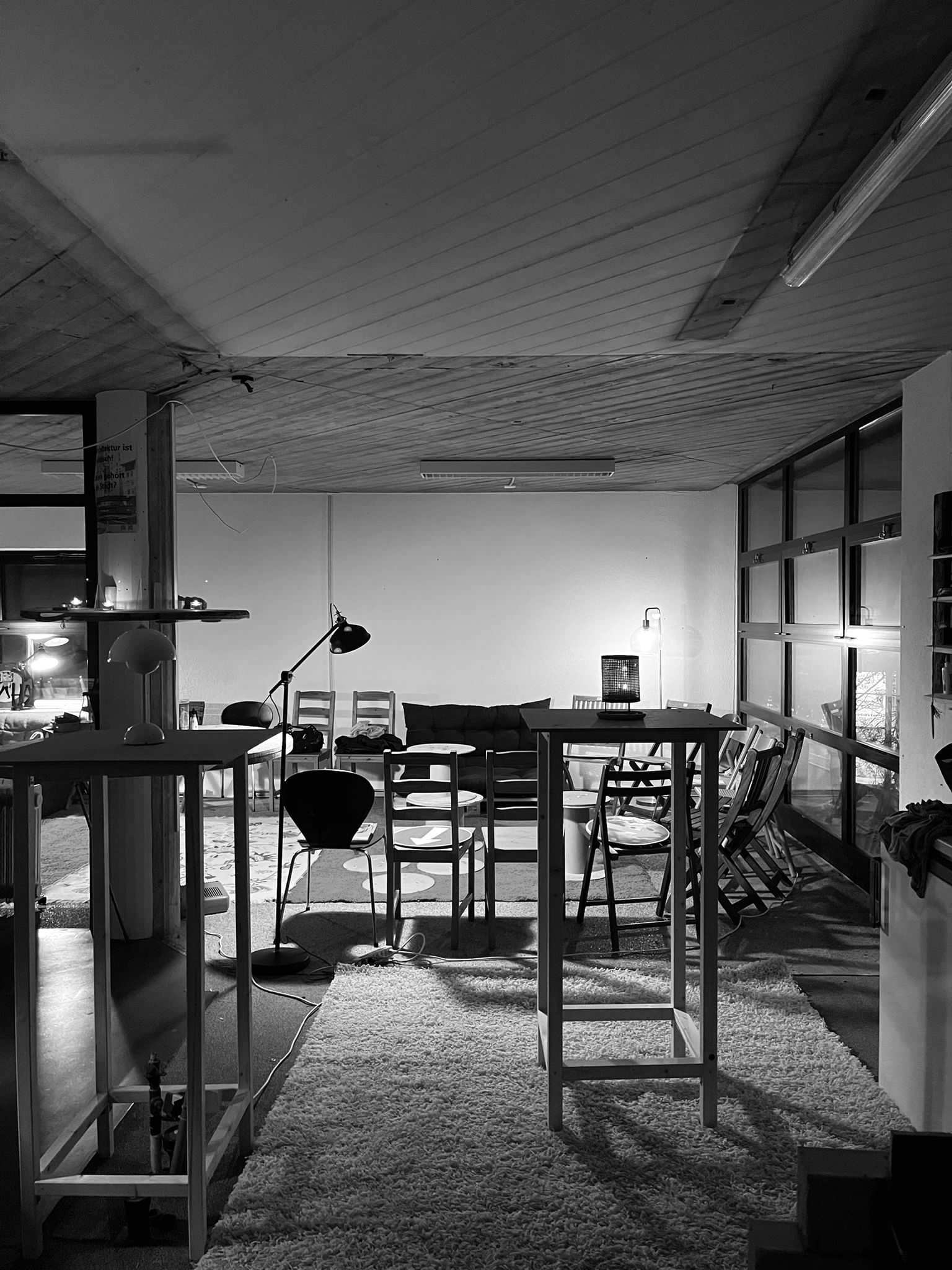
In this context, legitimacy does not announce itself loudly through deeds or signatures that circulate far above the ground. Instead, it emerges quietly through use and the stubborn fact of being there. Private property promises order but often produces distance, privileging those who invest over those who inhabit. The Parkhaus, a concrete ‘non-place’ filled with memories and traces that seem to escape control, challenges this logic. Here, marginalized groups find shelter and autonomy, creating a microterritory defined by care rather than contract, where rules loosen and new ways of living appear.
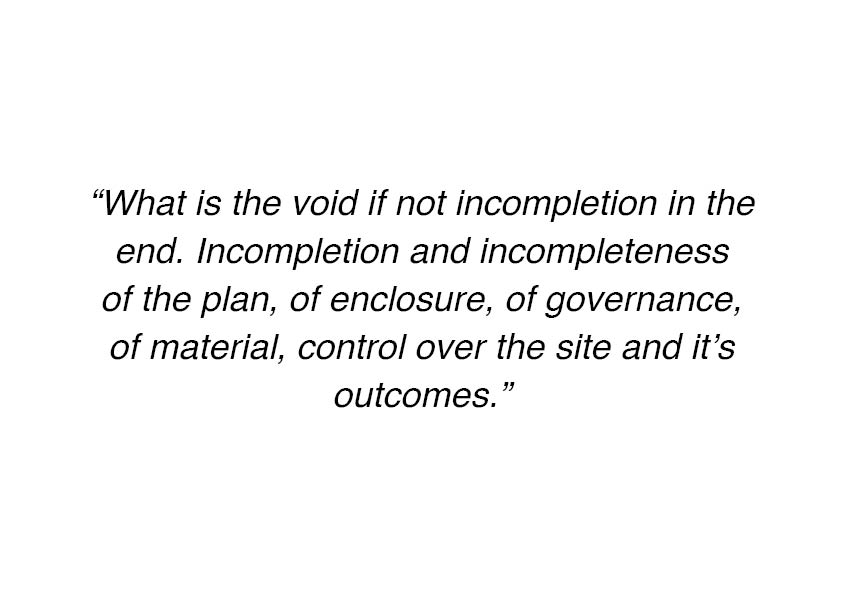
We argue that true resilience depends on what remains undecided. The capacity of the city to absorb shocks and transformations relies on these ‘margins of operation’, where adjustments occur without immediate conflict or displacement. In this context, architectural design necessitates a transition from merely creating objects to serving as a mediator of relationships and temporal dynamics. The empty space is not nothing; it is an active refusal of the imperative to optimize. Looking after these spaces becomes a radical political act of attention, for it is by maintaining these voids that we allow the city to breathe.
Architectural References
.jpg)
.jpg)
.jpg)
.jpg)
.jpg)
.jpg)
.jpg)
.jpg)
.jpg)
.jpg)
.jpg)
.jpg)
.jpg)
.jpg)
.jpg)
.jpg)
.jpg)
.jpg)
.jpg)
.jpg)
.jpg)
.jpg)
.jpg)
.jpg)
.jpg)
.jpg)
.jpg)
.jpg)
.jpg)
.jpg)
.jpg)
Theoretical References
.jpg)
.jpg)
.jpg)
.jpg)
.jpg)
.jpg)
.jpg)
.jpg)
.jpg)
.jpg)
.jpg)
.jpg)
.jpg)
.jpg)
.jpg)
.jpg)
.jpg)
Events
LET THE CITY BREATHE !
graphic novel & urban research project
ETH Zurich – Department of Architecture